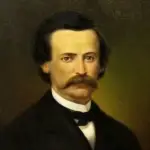
from The Shepheardes Calender: April

f
THENOT &HOBBINOLL
Tell me good Hobbinoll, what garres thee greete?
What? hath some Wolfe thy tender Lambes ytorne?
Or is thy Bagpype broke, that soundes so sweete?
Or art thou of thy loved lasse forlorne?

Or bene thine eyes attempred to the yeare,
Quenching the gasping furrowes thirst with rayne?
Like April shoure, so stremes the trickling teares
Adowne thy cheeke, to quenche thy thristye payne.

HOBBINOLL
Nor thys, nor that, so muche doeth make me mourne,
But for the ladde, whome long I lovd so deare,
Nowe loves a lasse, that all his love doth scorne:
He plongd in payne, his tressed locks dooth teare.

Shepheards delights he dooth them all forsweare,
Hys pleasaunt Pipe, whych made us meriment,
He wylfully hath broke, and doth forbeare
His wonted songs, wherein he all outwent.

THENOT
What is he for a Ladde, you so lament?
Ys love such pinching payne to them, that prove?
And hath he skill to make so excellent,
Yet hath so little skill to brydle love?

HOBBINOLL
Colin thou kenst, the Southerne shepheardes boye:
Him Love hath wounded with a deadly darte.
Whilome on him was all my care and joye,
Forcing with gyfts to winne his wanton heart.

But now from me hys madding mynd is starte,
And woes the Widdowes daughter of the glenne:
So nowe fayre Rosalind hath bredde hys smart,
So now his frend is chaunged for a frenne.

THENOT
But if hys ditties bene so trimly dight,
I pray thee Hobbinoll, recorde some one:
The whiles our flockes doe graze about in sight,
And we close shrowded in thys shade alone.

HOBBINOLL
Contented I: then will I singe his laye
Of fayre Elisa, Queene of shepheardes all:
Which once he made, as by a spring he laye,
And tuned it unto the Waters fall.

Ye dayntye Nymphs, that in this blessed Brooke
doe bathe your brest,
Forsake your watry bowres, and hether looke,
at my request:
And eke you Virgins, that on Parnasse dwell,
Whence floweth Helicon the learned well,
Helpe me to blaze
Her worthy praise,
Which in her sexe doth all excell.

Of fayre Eliza be your silver song,
that blessed wight:
The flowre of Virgins, may shee florish long,
In princely plight.
For shee is Syrinx daughter without spotte,
Which Pan the shepheards god of her begot:
So sprong her grace
Of heavenly race,
No mortall blemishe may her blotte.

See, where she sits upon the grassie greene,
(O seemely sight)
Yclad in Scarlot like a mayden Queene,
And Ermines white.
Upon her head a Cremosin coronet,
With Damaske roses and Daffadillies set:
Bayleaves betweene,
And Primroses greene
Embellish the sweete Violet.

Tell me, have ye seene her angelick face,
Like Ph{oe}be fayre?
Her heavenly haveour, her princely grace
can you well compare?
The Redde rose medled with the White yfere,
In either cheeke depeincten lively chere.
Her modest eye,
Her Majestie,
Where have you seene the like, but there?

I sawe Ph{oe}bus thrust out his golden hedde,
upon her to gaze:
But when he sawe, how broade her beames did spredde,
it did him amaze.
He blusht to see another Sunne belowe,
Ne durst againe his fyrye face out showe:
Let him, if he dare,
His brightnesse compare
With hers, to have the overthrowe.

Shewe thy selfe Cynthia with thy silver rayes,
and be not abasht:
When shee the beames of her beauty displayes,
O how art thou dasht?
But I will not match her with Latonaes seede,
Such follie great sorow to Niobe did breede.
Now she is a stone,
And makes dayly mone,
Warning all other to take heede.

Pan may be proud, that ever he begot
such a Bellibone,
And Syrinx rejoyse, that ever was her lot
to beare such an one.
Soone as my younglings cryen for the dam,
To her will I offer a milkwhite Lamb:
Shee is my goddesse plaine,
And I her shepherds swayne,
Albee forswonck and forswatt I am.

I see Calliope speede her to the place,
where my Goddesse shines:
And after her the other Muses trace,
with their Violines.
Bene they not Bay braunches, which they doe beare,
All for Elisa in her hand to weare?
So sweetely they play,
And sing all the way,
That it a heaven is to heare.

Lo how finely the graces can it foote
to the Instrument:
They dauncen deffly, and singen soote,
in their meriment.
Wants not a fourth grace, to make the daunce even?
Let that rowme to my Lady be yeven:
She shalbe a grace,
To fyll the fourth place,
And reigne with the rest in heaven.

And whither rennes this bevie of Ladies bright,
raunged in a rowe?
They bene all Ladyes of the lake behight,
that unto her goe.
Chloris, that is the chiefest Nymph of al,
Of Olive braunches beares a Coronall:
Olives bene for peace,
When wars doe surcease:
Such for a Princesse bene principall.

Ye shepheards daughters, that dwell on the greene,
hye you there apace:
Let none come there, but that Virgins bene,
to adorne her grace.
And when you come, whereas shee is in place,
See, that your rudeness doe not you disgrace:
Binde your fillets faste,
And gird in your waste,
For more finesse, with a tawdrie lace.

Bring hether the Pincke and purple Cullambine,
With Gelliflowres:
Bring Coronations, and Sops in wine,
worne of Paramoures.
Strowe me the ground with Daffadowndillies,
And Cowslips, and Kingcups, and loved Lillies:
The pretie Pawnce,
And the Chevisaunce,
Shall match with the fayre flowre Delice.

Now ryse up Elisa, decked as thou art,
in royall aray:
And now ye daintie Damsells may depart
echeone her way,
I feare, I have troubled your troupes to longe:
Let dame Eliza thanke you for her song.
And if you come hether,
When Damsines I gether,
I will part them all you among.

THENOT
And was thilk same song of Colins owne making?
Ah foolish boy, that is with love yblent:
Great pittie is, he be in such taking,
For naught caren, that bene so lewdly bent.

HOBBINOLL
Sicker I hold him, for a greater fon,
That loves the thing, he cannot purchase.
But let us homeward: for night draweth on,
And twincling starres the daylight hence chase.

THENOTS EMBLEME
O quam te memorem virgo?

HOBBINOLLS EMBLEME
O dea certe.

599
Rating:

Comment form:

*Max text - 1500. Manual moderation.

Similar Poems:

from “Poems for Blok” by Marina Tsvetaeva
Marina Tsvetaeva
Your name is a—bird in my hand,
a piece of ice on my tongue.
The lips’ quick opening.
Your name—four letters.
A ball caught in flight,
a silver bell in my mouth.

A stone thrown into a silent lake
is—the sound of your name.
Read Poem
0
675
Rating:

Take, Oh, Take Those Lips Away by John Fletcher
John Fletcher
Take, oh, take those lips away
That so sweetly were forsworn
And those eyes, like break of day,
Lights that do mislead the morn;
But my kisses bring again,
Seals of love, though sealed in vain.

Hide, oh, hide those hills of snow,
Read Poem
0
707
Rating:

The Drum Major of the Freedom Parade by Margaret Burroughs
Margaret Burroughs
(For all children who wondered about the tragic event of April 4, 1968 at Memphis.) My children, my children, remember the day
When the Drum Major of Freedom's parade went away.
Stop crying now little children and listen
And you will know for the future what really did happen.

You will know why your father was solemn and grim
And why mother's eyes were wet at the rim.
You will know why the flags flew at half mast
Read Poem
0
569
Rating:

Voyages by Hart Crane
Hart Crane
I

Above the fresh ruffles of the surf
Bright striped urchins flay each other with sand.
They have contrived a conquest for shell shucks,
And their fingers crumble fragments of baked weed
Gaily digging and scattering.

And in answer to their treble interjections
The sun beats lightning on the waves,
Read Poem
0
969
Rating:

Sonnet 104: To me, fair friend, you never can be old by William Shakespeare
William Shakespeare
To me, fair friend, you never can be old,
For as you were when first your eye I eyed,
Such seems your beauty still. Three winters cold
Have from the forests shook three summers’ pride,
Three beauteous springs to yellow autumn turned
In process of the seasons have I seen,
Three April perfumes in three hot Junes burned,
Since first I saw you fresh, which yet are green.
Ah, yet doth beauty, like a dial-hand,
Steal from his figure, and no pace perceived;
So your sweet hue, which methinks still doth stand,
Hath motion, and mine eye may be deceived:
For fear of which, hear this, thou age unbred:
Ere you were born was beauty’s summer dead.
Read Poem
0
836
Rating:

Six Songs of Love, Constancy, Romance, Inconstancy, Truth, and Marriage by Letitia Elizabeth Landon
Letitia Elizabeth Landon
Oh! yet one smile, tho' dark may lower
Around thee clouds of woe and ill,
Let me yet feel that I have power,
Mid Fate's bleak storms, to soothe thee still.

Tho' sadness be upon thy brow,
Yet let it turn, dear love, to me,
I cannot bear that thou should'st know
Sorrow I do not share with thee.
Read Poem
0
963
Rating:

Twelve Songs: IX by W. H. Auden
W. H. Auden
April 1936 Stop all the clocks, cut off the telephone,
Prevent the dog from barking with a juicy bone,
Read Poem
0
1.2K
Rating:

Hymn to Life by James Schuyler
James Schuyler
The wind rests its cheek upon the ground and feels the cool damp
And lifts its head with twigs and small dead blades of grass
Pressed into it as you might at the beach rise up and brush away
The sand. The day is cool and says, “I’m just staying overnight.”
The world is filled with music, and in between the music, silence
And varying the silence all sorts of sounds, natural and man made:
There goes a plane, some cars, geese that honk and, not here, but
Not so far away, a scream so rending that to hear it is to be
Read Poem
0
1.1K
Rating:

from The Prodigal: 10 by Derek Walcott
Derek Walcott
I

The ground dove stuttered for a few steps then flew
up from his path to settle in the sun-browned
branches that were now barely twigs; in drought it coos
with its relentless valve, a tiring sound,
not like the sweet exchanges of turtles in the Song
of Solomon, or the flutes of Venus in frescoes
though all the mounds in the dove-calling drought
Read Poem
0
589
Rating:

The Rime of the Ancient Mariner (text of 1834) by Samuel Taylor Coleridge
Samuel Taylor Coleridge
Argument

How a Ship having passed the Line was driven by storms to the cold Country towards the South Pole; and how from thence she made her course to the tropical Latitude of the Great Pacific Ocean; and of the strange things that befell; and in what manner the Ancyent Marinere came back to his own Country. PART I
It is an ancient Mariner,
And he stoppeth one of three.
'By thy long grey beard and glittering eye,
Read Poem
0
931
Rating:

The Canticle of Jack Kerouac by Lawrence Ferlinghetti
Lawrence Ferlinghetti
1.

Far from the sea far from the sea
of Breton fishermen
the white clouds scudding
over Lowell
and the white birches the
bare white birches
along the blear night roads
Read Poem
0
844
Rating:

And Now She Has Disappeared in Water by Diane Wakoski
Diane Wakoski
For Marilyn who died in January april 1
Read Poem
0
884
Rating:

Negroes by Charles Reznikoff
Charles Reznikoff
1

One night in April or May,
his daughter saw someone's hand
make the curtain which was drawn tightly across her window bulge
and ran to the adjoining room in her night clothes
where he and his son were sitting.
He ran around the house one way
and his son ran the other way
Read Poem
0
617
Rating:

The Waste Land by T. S. Eliot
T. S. Eliot
‘Nam Sibyllam quidem Cumis ego ipse oculis meis vidi in ampulla pendere, et cum illi pueri dicerent:Σίβυλλα τίθέλεις; respondebat illa:άποθανεîνθέλω.’ For Ezra Pound
il miglior fabbro. I. The Burial of the Dead
Read Poem
0
985
Rating:

The Hook by Theodore Weiss
Theodore Weiss
I

The students, lost in raucousness,
caught as by the elder Breughel’s eye,
we sit in the college store
over sandwiches and coffee, wondering.
She answers eagerly: the place was fine;
sometimes the winds grew very cold,
the snows so deep and wide she lost
Read Poem
0
578
Rating:

Symphony of a Mexican Garden by Grace Hazard Conkling
Grace Hazard Conkling
1. THE GARDEN Poco sostenuto in A major
The laving tide of inarticulate air.

Vivace in A major
The iris people dance.

2. THE POOL Allegretto in A minor
Cool-hearted dim familiar of the dove.

3. THE BIRDSPresto in F major
I keep a frequent tryst.

Presto meno assai
The blossom-powdered orangeitree.

Read Poem
0
620
Rating:

Toward an Organic Philosophy by Kenneth Rexroth
Kenneth Rexroth
SPRING, COAST RANGE

The glow of my campfire is dark red and flameless,
The circle of white ash widens around it.
I get up and walk off in the moonlight and each time
I look back the red is deeper and the light smaller.
Scorpio rises late with Mars caught in his claw;
The moon has come before them, the light
Like a choir of children in the young laurel trees.
Read Poem
0
666
Rating:

The Unknown Dead by Henry Timrod
Henry Timrod
The rain is plashing on my sill,
But all the winds of Heaven are still;
And so it falls with that dull sound
Which thrills us in the church-yard ground,
When the first spadeful drops like lead
Upon the coffin of the dead.
Beyond my streaming window-pane,
I cannot see the neighboring vane,
Yet from its old familiar tower
The bell comes, muffled, through the shower.
What strange and unsuspected link
Of feeling touched, has made me think—
While with a vacant soul and eye
I watch that gray and stony sky—
Of nameless graves on battle-plains
Read Poem
0
611
Rating:

What the Birds Said by John Greenleaf Whittier
John Greenleaf Whittier
The birds against the April wind
Flew northward, singing as they flew;
They sang, “The land we leave behind
Has swords for corn-blades, blood for dew.”

“O wild-birds, flying from the South,
What saw and heard ye, gazing down?”
“We saw the mortar’s upturned mouth,
Read Poem
0
614
Rating:

The Argument of his Book by Robert Herrick
Robert Herrick
I sing of brooks, of blossoms, birds, and bowers,
Of April, May, of June, and July flowers.
I sing of May-poles, hock-carts, wassails, wakes,
Of bridegrooms, brides, and of their bridal-cakes.
I write of youth, of love, and have access
By these to sing of cleanly wantonness.
I sing of dews, of rains, and piece by piece
Of balm, of oil, of spice, and ambergris.
Read Poem
0
648
Rating: