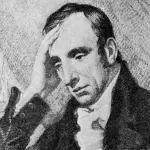
The World Is Too Much With Us

T
The world is too much with us; late and soon,
Getting and spending, we lay waste our powers;—
Little we see in nature that is ours;
We have given our hearts away, a sordid boon!
This sea that bares her bosom to the moon;
The winds that will be howling at all hours,
And are up-gathered now like sleeping flowers;
For this, for everything, we are out of tune;
It moves us not. Great god! I’d rather be
A Pagan suckled in a creed outworn;
So might I, standing on this pleasant lea,
Have glimpses that would make me less forlorn;
Have sight of Proteus rising from the sea;
Or hear old Triton blow his wreathèd horn.
865
Rating:

Comment form:

*Max text - 1500. Manual moderation.

Similar Poems:

Felix Randal by Gerard Manley Hopkins
Gerard Manley Hopkins
Felix Randal the farrier, O is he dead then? my duty all ended,
Who have watched his mould of man, big-boned and hardy-handsome
Pining, pining, till time when reason rambled in it, and some
Fatal four disorders, fleshed there, all contended?

Sickness broke him. Impatient, he cursed at first, but mended
Being anointed and all; though a heavenlier heart began some
Months earlier, since I had our sweet reprieve and ransom
Tendered to him. Ah well, God rest him all road ever he offended!

This seeing the sick endears them to us, us too it endears.
My tongue had taught thee comfort, touch had quenched thy tears,
Thy tears that touched my heart, child, Felix, poor Felix Randal;

How far from then forethought of, all thy more boisterous years,
Read Poem
0
933
Rating:

Morning Song and Evening Walk by Sonia Sanchez
Sonia Sanchez
1.

Tonite in need of you
and God
I move imperfect
through this ancient city.

Quiet. No one hears
No one feels the tears
of multitudes.
Read Poem
0
1.1K
Rating:

Song by Stephen Spender
Stephen Spender
Stranger, you who hide my love
In the curved cheek of a smile
And sleep with her upon a tongue
Of soft lies that beguile,
Your paradisal ecstasy
Is justified is justified
By hunger of the beasts beneath
The overhanging cloud
Read Poem
0
907
Rating:

Incidents of Travel in Poetry by Frank Lima
Frank Lima
Happy Birthday Kenneth Koch/Feb 27 We went to all those places where they restore sadness and joy
and call it art. We were piloted by Auden who became
Unbearably acrimonious when we dropped off Senghor into the
steamy skies of his beloved West Africa. The termites and ants
Read Poem
0
1.1K
Rating:

Ode on Solitude by Alexander Pope
Alexander Pope
Happy the man, whose wish and care
A few paternal acres bound,
Content to breathe his native air,
In his own ground.

Whose herds with milk, whose fields with bread,
Whose flocks supply him with attire,
Whose trees in summer yield him shade,
In winter fire.

Blest, who can unconcernedly find
Hours, days, and years slide soft away,
In health of body, peace of mind,
Quiet by day,

Read Poem
0
835
Rating:

Pantoum of the Great Depression by Donald Justice
Donald Justice
Our lives avoided tragedy
Simply by going on and on,
Without end and with little apparent meaning.
Oh, there were storms and small catastrophes.

Simply by going on and on
We managed. No need for the heroic.
Oh, there were storms and small catastrophes.
I don't remember all the particulars.
Read Poem
0
1.0K
Rating:

Snails by Francis Ponge
Francis Ponge
Unlike the ashes that make their home with hot coals, snails prefer moist earth. Go on: they advance while gluing themselves to it with their entire bodies. They carry it, they eat it, they shit it. They go through it, it goes through them. It’s the best kind of interpenetration, as between tones, one passive and one active. The passive bathes and nourishes the active, which overturns the other while it eats.

(There is more to be said about snails. First of all their immaculate clamminess. Their sangfroid. Their stretchiness.)

One can scarcely conceive of a snail outside its shell and unmoving. The moment it rests it sinks down deep into itself. In fact, its modesty obliges it to move as soon as it has shown its nakedness and 
revealed its vulnerable shape. The moment it’s exposed, it moves on.

During periods of dryness they withdraw into ditches where it seems their bodies are enough to maintain their dampness. No doubt their neighbors there are toads and frogs and other ectothermic animals. But when they come out again they don’t move as quickly. You have to admire their willingness to go into the ditch, given how hard it is for them to come out again.

Note also that though snails like moist soil, they have no affection for places that are too wet such as marshes or ponds. Most assuredly they prefer firm earth, as long as it’s fertile and damp.

They are fond as well of moisture-rich vegetables and green leafy plants. They know how to feed on them leaving only the veins, cutting free the most tender leaves. They are hell on salads.

What are these beings from the depths of the ditches? Though snails love many of their trenches’ qualities they have every intention of leaving. They are in their element but they are also wanderers. And when they emerge into the daylight onto firm ground their shells will preserve their vagabond’s hauteur.

It must be a pain to have to haul that trailer around with them everywhere, but they never complain and in the end they are happy about it. How valuable, after all, to be able to go home any time, no matter where you may find yourself, eluding all intruders. It must be worth it.
Read Poem
0
1.5K
Rating:

In a London Drawingroom by George Eliot
George Eliot
The sky is cloudy, yellowed by the smoke.
For view there are the houses opposite
Cutting the sky with one long line of wall
Like solid fog: far as the eye can stretch
Monotony of surface & of form
Without a break to hang a guess upon.
No bird can make a shadow as it flies,
For all is shadow, as in ways o'erhung
By thickest canvass, where the golden rays
Are clothed in hemp. No figure lingering
Pauses to feed the hunger of the eye
Or rest a little on the lap of life.
All hurry on & look upon the ground,
Or glance unmarking at the passers by
The wheels are hurrying too, cabs, carriages
Read Poem
0
843
Rating:

From “Five Poems” by Edward Dahlberg
Edward Dahlberg
I
He who has never tasted the grapes of Canaan can only view them from Pisgah.

I have my tides, O sea-foamed Venus, dearer than watercress, pipkins, thyme and clymene. You once held me by the cord of my navel, but I have not died to live in Mahomet’s paradise.

Would that I could gather up my love to me as one does one’s fate, or measure her nature as God does the sea.

We are a weary race that hates seedtime. Poor Persephone, who is Maying springtime, and the coming up of flowers! We remember only what we seed, and Persephone goes down into the earth after Spring and Summer vegetation only because Pluto gave her pomegranate seeds to remember him, but if the seed perish, Persephone will die, and memory shall pass from the earth.

A man of humble blood, with a soul of Kidron, needs a Rachel, but I labored for years in the weary fields for Leah.II
The world is a wound in my soul, and I have sought the living waters in meditation, and the angelical fountains in the desert of Beersheba for solitude, for what health there is in friendship comes when one is alone.

I shed tears on the Mount of Olives because people no longer care for each other, but my friends have lacked the character for the vigil. There is no Cana wine in human affections that are not always awake, for people who do not trouble about each other are foes.

It is humiliating being the lamb and bleating to each passerby, “Feed me!” What is the use of saying that men are stones when I know I am going to try to turn them into bread.

I am afraid to say that people are truthful. When a man tells me he is honest I press my hand close to my heart where I keep my miserable wallet. If he says he has any goodness in him, I avoid him, for I trust nobody who has so little fear of the evils that grow and ripen in us while we imagine we have one virtuous trait. These demons lie in ambush in the thick, heady coverts of the blood, where hypocrisy and egoism fatten, waiting to mock or betray us in any moment of self-esteem.

I have no faith in a meek man, and regard anyone that shows a humble mien as one who is preparing to make an attack upon me, for there is some brutish, nether fault in starved vanity.

Yet once a friend leaned as gently on my coat as that disciple had on the bosom of the Saviour, and I went away, not knowing by his affection whether I was the John Christ was said to have loved most. I whispered thanks to my soul because he leaned upon me, for I shall never know who I am if I am not loved.

V
Much flesh walks upon the earth void of heart and warm liver, for it is the spirit that dies soonest.

Some men have marshland natures with mist and sea-water in their intellects, and are as sterile as the Florida earth which De Soto found in those meager, rough Indian settlements, and their tongues are fierce, reedy arrows. They wound and bleed the spirit, and their oaks and chestnut trees and acorns are wild, and a terrible, barren wind from the Atlantic blows through their blood as pitiless as the primitive rivers De Soto’s soldiers could not ford.

Do not attempt to cross these mad, tumid rivers, boreal and brackish, for water is unstable, and you cannot link yourself to it.

There are also inland, domestic men who are timid pulse and vetch, and though they may appear as stupid as poultry rooting in the mire, they are housed people, and they have orchards and good, tamed wine that makes men loving rather than predatory; go to them, and take little thought of their ignorance which brings forth good fruits, for here you may eat and not be on guard for the preservation of your soul.

People who have domestic animals are patient, for atheism and the stony heart are the result of traveling: sorrow never goes anywhere. Were we as content as our forefathers were with labor in the fallow, or as a fuller with his cloth, or a drayman with his horses and mules, we would stay where we are, and that is praying.

There are men that are birds, and their raiment is trembling feathers, for they show their souls to everyone, and everything that is ungentle or untutored or evil or mockery is as a rude stone cast at them, and they suffer all day long, or as Paul remarks they are slain every moment.

God forgive me for my pride; though I would relinquish my own birthright for that wretched pottage of lentils which is friendship, I mistrust every mortal.

Each day the alms I ask of heaven is not to have a new chagrin which is my daily bread.

December 1959
Read Poem
0
1.0K
Rating:

Somewhere i have never travelled, gladly beyond by E. E. Cummings
E. E. Cummings
somewhere i have never travelled, gladly beyond
any experience, your eyes have their silence:
in your most frail gesture are things which enclose me,
or which i cannot touch because they are too near

your slightest look easily will unclose me
though i have closed myself as fingers,
you open always petal by petal myself as Spring opens
(touching skilfully, mysteriously) her first rose
Read Poem
0
1.0K
Rating:

Nosce Teipsum: of Human Knowledge by John Davies
John Davies
Why did my parents send me to the schools
That I with knowledge might enrich my mind?
Since the desire to know first made men fools,
And did corrupt the root of all mankind.

Read Poem
0
1.1K
Rating:

The Wind at the Door by William Barnes
William Barnes
As day did darken on the dewless grass,
There, still, wi’ nwone a-come by me
To stay a-while at hwome by me
Within the house, all dumb by me,
I zot me sad as the eventide did pass.

An’ there a win’blast shook the rattlèn door,
An’ seemed, as win’ did mwoan without,
Read Poem
0
895
Rating:

Finale by Pablo Neruda
Pablo Neruda
Matilde, years or days
sleeping, feverish,
here or there,
gazing off,
twisting my spine,
bleeding true blood,
perhaps I awaken
or am lost, sleeping:
Read Poem
0
932
Rating:

The Garden of Proserpine by Algernon Charles Swinburne
Algernon Charles Swinburne
Here, where the world is quiet;
Here, where all trouble seems
Dead winds' and spent waves' riot
In doubtful dreams of dreams;
I watch the green field growing
For reaping folk and sowing,
For harvest-time and mowing,
A sleepy world of streams.

I am tired of tears and laughter,
And men that laugh and weep;
Of what may come hereafter
For men that sow to reap:
I am weary of days and hours,
Blown buds of barren flowers,
Read Poem
0
1.2K
Rating:

Speech: “Is this a dagger which I see before me” by William Shakespeare
William Shakespeare
(from Macbeth, spoken by Macbeth) Is this a dagger which I see before me,
The handle toward my hand? Come, let me clutch thee.
I have thee not, and yet I see thee still.
Art thou not, fatal vision, sensible
To feeling as to sight? or art thou but
A dagger of the mind, a false creation,
Proceeding from the heat-oppressed brain?
Read Poem
0
1.0K
Rating:

Walsinghame by Sir Walter Ralegh
Sir Walter Ralegh
As you came from the holy land
of Walsinghame
Met you not with my true love
By the way as you came?

How shall I know your true love
That have met many one
As I went to the holy land
Read Poem
0
885
Rating:

And There Was a Great Calm by Thomas Hardy
Thomas Hardy
(On the Signing of the Armistice, 11 Nov. 1918)
I
There had been years of Passion—scorching, cold,
Read Poem
0
1.1K
Rating:

Doctor Meyers by Edgar Lee Masters
Edgar Lee Masters
No other man, unless it was Doc Hill,
Did more for people in this town than l.
And all the weak, the halt, the improvident
And those who could not pay flocked to me.
I was good-hearted, easy Doctor Meyers.
I was healthy, happy, in comfortable fortune,
Blest with a congenial mate, my children raised,
All wedded, doing well in the world.
Read Poem
0
831
Rating:

Because I could not stop for Death by Emily Dickinson
Emily Dickinson
Because I could not stop for Death,
He kindly stopped for me;
The Carriage held but just Ourselves
And Immortality.

We slowly drove – He knew no haste
And I had put away
My labor and my leisure too,
For His Civility.
Read Poem
1
1.2K
Rating:

from Don Juan: Canto 1, Stanzas 60-63 by Lord Byron (George Gordon)
Lord Byron (George Gordon)
60
Her eye (I'm very fond of handsome eyes)
Was large and dark, suppressing half its fire
Until she spoke, then through its soft disguise
Flash'd an expression more of pride than ire,
And love than either; and there would arise
A something in them which was not desire,
But would have been, perhaps, but for the soul
Which struggled through and chasten'd down the whole.

61
Her glossy hair was cluster'd o'er a brow
Bright with intelligence, and fair, and smooth;
Her eyebrow's shape was like the aerial bow,
Her cheek all purple with the beam of youth,
Read Poem
0
873
Rating: