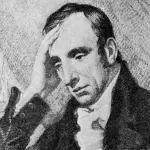
Simon Lee: The Old Huntsman

S
In the sweet shire of Cardigan,
Not far from pleasant Ivor-hall,
An old Man dwells, a little man,—
'Tis said he once was tall.
For five-and-thirty years he lived
A running huntsman merry;
And still the centre of his cheek
Is red as a ripe cherry.

No man like him the horn could sound,
And hill and valley rang with glee
When Echo bandied, round and round
The halloo of Simon Lee.
In those proud days, he little cared
For husbandry or tillage;
To blither tasks did Simon rouse
The sleepers of the village.

He all the country could outrun,
Could leave both man and horse behind;
And often, ere the chase was done,
He reeled, and was stone-blind.
And still there's something in the world
At which his heart rejoices;
For when the chiming hounds are out,
He dearly loves their voices!

But, oh the heavy change!—bereft
Of health, strength, friends, and kindred, see!
Old Simon to the world is left
In liveried poverty.
His Master's dead—and no one now
Dwells in the Hall of Ivor;
Men, dogs, and horses, all are dead;
He is the sole survivor.

And he is lean and he is sick;
His body, dwindled and awry,
Rests upon ankles swoln and thick;
His legs are thin and dry.
One prop he has, and only one,
His wife, an aged woman,
Lives with him, near the waterfall,
Upon the village Common.

Beside their moss-grown hut of clay,
Not twenty paces from the door,
A scrap of land they have, but they
Are poorest of the poor.
This scrap of land he from the heath
Enclosed when he was stronger;
But what to them avails the land
Which he can till no longer?

Oft, working by her Husband's side,
Ruth does what Simon cannot do;
For she, with scanty cause for pride,
Is stouter of the two.
And, though you with your utmost skill
From labour could not wean them,
'Tis little, very little—all
That they can do between them.

Few months of life has he in store
As he to you will tell,
For still, the more he works, the more
Do his weak ankles swell.
My gentle Reader, I perceive,
How patiently you've waited,
And now I fear that you expect
Some tale will be related.

O Reader! had you in your mind
Such stores as silent thought can bring,
O gentle Reader! you would find
A tale in every thing.
What more I have to say is short,
And you must kindly take it:
It is no tale; but, should you think,
Perhaps a tale you'll make it.

One summer-day I chanced to see
This old Man doing all he could
To unearth the root of an old tree,
A stump of rotten wood.
The mattock tottered in his hand;
So vain was his endeavour,
That at the root of the old tree
He might have worked for ever.

"You're overtasked, good Simon Lee,
Give me your tool," to him I said;
And at the word right gladly he
Received my proffered aid.
I struck, and with a single blow
The tangled root I severed,
At which the poor old Man so long
And vainly had endeavoured.

The tears into his eyes were brought,
And thanks and praises seemed to run
So fast out of his heart, I thought
They never would have done.
—I've heard of hearts unkind, kind deeds
With coldness still returning;
Alas! the gratitude of men
Hath oftener left me mourning.

498
Rating:

Comment form:

*Max text - 1500. Manual moderation.

Similar Poems:

The Song of Wandering Aengus by William Butler Yeats
William Butler Yeats
I went out to the hazel wood,
Because a fire was in my head,
And cut and peeled a hazel wand,
And hooked a berry to a thread;
And when white moths were on the wing,
And moth-like stars were flickering out,
I dropped the berry in a stream
And caught a little silver trout.

When I had laid it on the floor
I went to blow the fire a-flame,
But something rustled on the floor,
And someone called me by my name:
It had become a glimmering girl
With apple blossom in her hair
Read Poem
3
1.5K
Rating:

A Dog Has Died by Pablo Neruda
Pablo Neruda
My dog has died.
I buried him in the garden
next to a rusted old machine.

Some day I'll join him right there,
but now he's gone with his shaggy coat,
his bad manners and his cold nose,
and I, the materialist, who never believed
in any promised heaven in the sky
Read Poem
0
659
Rating:

Chinese Whispers by John Ashbery
John Ashbery
And in a little while we broke under the strain:
suppurations ad nauseam, the wanting to be taller,
though it‘s simply about being mysterious, i.e., not taller,
like any tree in any forest.
Mute, the pancake describes you.
It had tiny roman numerals embedded in its rim.
It was a pancake clock. They had ’em in those days,
always getting smaller, which is why they finally became extinct.
Read Poem
0
670
Rating:

Incidents of Travel in Poetry by Frank Lima
Frank Lima
Happy Birthday Kenneth Koch/Feb 27 We went to all those places where they restore sadness and joy
and call it art. We were piloted by Auden who became
Unbearably acrimonious when we dropped off Senghor into the
steamy skies of his beloved West Africa. The termites and ants
Read Poem
0
675
Rating:

Thyrsis: A Monody, to Commemorate the Author's Friend, Arthur Hugh Clough by Matthew Arnold
Matthew Arnold
How changed is here each spot man makes or fills!
In the two Hinkseys nothing keeps the same;
The village street its haunted mansion lacks,
And from the sign is gone Sibylla's name,
And from the roofs the twisted chimney-stacks—
Are ye too changed, ye hills?
See, 'tis no foot of unfamiliar men
To-night from Oxford up your pathway strays!
Read Poem
0
529
Rating:

Heart’s Needle by W. D. Snodgrass
W. D. Snodgrass
For Cynthia

When he would not return to fine garments and good food, to his houses and his people, Loingseachan told him, “Your father is dead.” “I’m sorry to hear it,” he said. “Your mother is dead,” said the lad. “All pity for me has gone out of the world.” “Your sister, too, is dead.” “The mild sun rests on every ditch,” he said; “a sister loves even though not loved.” “Suibhne, your daughter is dead.” “And an only daughter is the needle of the heart.” “And Suibhne, your little boy, who used to call you “Daddy”—he is dead.” “Aye,” said Suibhne, “that’s the drop that brings a man to the ground.”
He fell out of the yew tree; Loingseachan closed his arms around him and placed him in manacles.—AFTER THE MIDDLE-IRISH ROMANCE, THE MADNESS OF SUIBHNE
Read Poem
0
806
Rating:

Hotel François 1er by Gertrude Stein
Gertrude Stein
It was a very little while and they had gone in front of it. It was that they had liked it would it bear. It was a very much adjoined a follower. Flower of an adding where a follower.
Have I come in. Will in suggestion.
They may like hours in catching.
It is always a pleasure to remember.
Have a habit.
Any name will very well wear better.
All who live round about there.
Have a manner.
The hotel François Ier.
Just winter so.
It is indubitably often that she is as denied to soften help to when it is in all in midst of which in vehemence to taken given in a bestowal show than left help in double.
Having noticed often that it is newly noticed which makes older often.
The world has become smaller and more beautiful.
The world is grown smaller and more beautiful. That is it.
Yes that is it.
Read Poem
0
598
Rating:

Amoretti IV: "New yeare forth looking out of Janus gate" by Edmund Spenser
Edmund Spenser
New yeare forth looking out of Janus gate,
Doth seeme to promise hope of new delight:
And bidding th’old Adieu, his pass
Read Poem
0
434
Rating:

from Don Juan: Canto 1, Stanzas 217-221 by Lord Byron (George Gordon)
Lord Byron (George Gordon)
217
Ambition was my idol, which was broken
Before the shrines of Sorrow and of Pleasure;
And the two last have left me many a token
O'er which reflection may be made at leisure:
Now, like Friar Bacon's brazen head, I've spoken,
'Time is, Time was, Time's past', a chymic treasure
Is glittering youth, which I have spent betimes—
My heart in passion, and my head on rhymes.
Read Poem
0
563
Rating:

A Child's Drawing, 1941 by Jean Valentine
Jean Valentine
A woman ladder leans
with her two-year-old boy in her arms.
Her arms & legs & hands & feet
are thin as crayons.

The man ladder
is holding his glass of bourbon,
he is coming out of the child’s drawing
in his old open pajamas—
Read Poem
0
427
Rating:

Musée des Beaux Arts by W. H. Auden
W. H. Auden
December 1938 About suffering they were never wrong,
The Old Masters: how well they understood
Read Poem
0
620
Rating:

A Friendly Address by Thomas Hood
Thomas Hood
TO MRS. FRY IN NEWGATE

Sermons in stones.—As You Like It.
Out! out! damned spot.—Macbeth. I like you, Mrs. Fry! I like your name!
Read Poem
0
709
Rating:

Jenny by Dante Gabriel Rossetti
Dante Gabriel Rossetti
“Vengeance of Jenny’s case! Fie on her! Never name her, child!”—Mrs. Quickly Lazy laughing languid Jenny,
Fond of a kiss and fond of a guinea,
Read Poem
0
770
Rating:

Ave Atque Vale by Algernon Charles Swinburne
Algernon Charles Swinburne
In Memory of Charles Baudelaire

Nous devrions pourtant lui porter quelques fleurs;
Les morts, les pauvres morts, ont de grandes douleurs,
Et quand Octobre souffle, émondeur des vieux arbres,
Son vent mélancolique àl'entour de leurs marbres,
Certe, ils doivent trouver les vivants bien ingrats.

Les Fleurs du Mal.
I
Shall I strew on thee rose or rue or laurel,
Brother, on this that was the veil of thee?
Or quiet sea-flower moulded by the sea,
Read Poem
0
667
Rating:

I Dreamed That I Was Old by Stanley Kunitz
Stanley Kunitz
I dreamed that I was old: in stale declension
Fallen from my prime, when company
Was mine, cat-nimbleness, and green invention,
Before time took my leafy hours away.

My wisdom, ripe with body’s ruin, found
Itself tart recompense for what was lost
In false exchange: since wisdom in the ground
Has no apocalypse or pentecost.
Read Poem
0
461
Rating:

A Vision of Poesy by Henry Timrod
Henry Timrod
PART I

I
In a far country, and a distant age,
Ere sprites and fays had bade farewell to earth,
A boy was born of humble parentage;
The stars that shone upon his lonely birth
Did seem to promise sovereignty and fame—
Yet no tradition hath preserved his name.

II
’T is said that on the night when he was born,
A beauteous shape swept slowly through the room;
Its eyes broke on the infant like a morn,
And his cheek brightened like a rose in bloom;
Read Poem
0
781
Rating:

Prospects by Anthony Hecht
Anthony Hecht
We have set out from here for the sublime
Pastures of summer shade and mountain stream;
I have no doubt we shall arrive on time.

Is all the green of that enameled prime
A snapshot recollection or a dream?
We have set out from here for the sublime

Without provisions, without one thin dime,
And yet, for all our clumsiness, I deem
Read Poem
0
562
Rating:

America by Allen Ginsberg
Allen Ginsberg
America I’ve given you all and now I’m nothing.
America two dollars and twentyseven cents January 17, 1956.
I can’t stand my own mind.
America when will we end the human war?
Go fuck yourself with your atom bomb.
I don’t feel good don’t bother me.
I won’t write my poem till I’m in my right mind.
America when will you be angelic?
Read Poem
0
802
Rating:

The Eve of St. Agnes by John Keats
John Keats
St. Agnes' Eve—Ah, bitter chill it was!
The owl, for all his feathers, was a-cold;
The hare limp'd trembling through the frozen grass,
And silent was the flock in woolly fold:
Numb were the Beadsman's fingers, while he told
His rosary, and while his frosted breath,
Like pious incense from a censer old,
Seem'd taking flight for heaven, without a death,
Past the sweet Virgin's picture, while his prayer he saith.

His prayer he saith, this patient, holy man;
Then takes his lamp, and riseth from his knees,
And back returneth, meagre, barefoot, wan,
Along the chapel aisle by slow degrees:
The sculptur'd dead, on each side, seem to freeze,
Read Poem
0
793
Rating:

Cleon by Robert Browning
Robert Browning
"As certain also of your own poets have said"—
(Acts 17.28)
Cleon the poet (from the sprinkled isles,
Lily on lily, that o'erlace the sea
And laugh their pride when the light wave lisps "Greece")—
To Protus in his Tyranny: much health!
Read Poem
0
840
Rating: