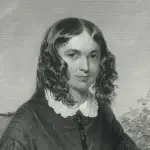
from Aurora Leigh, First Book

f
In those days, though, I never analysed
Myself even. All analysis comes late.
You catch a sight of nature, earliest,
In full front sun-face, and your eyelids wink
And drop before the wonder of ‘t; you miss
The form, through seeing the light. I lived, those days,
And wrote because I lived–unlicensed else:
My heart beat in my brain. Life’s violent flood
Abolished bounds,–and, which my neighbour’s field,
Which mine, what mattered? It is so in youth.
We play at leap-frog over the god Term;
The love within us and the love without
Are mixed, confounded; if we are loved or love,
We scarce distinguish. So, with other power.
Being acted on and acting seem the same:
In that first onrush of life’s chariot-wheels,
We know not if the forests move or we.
And so, like most young poets, in a flush
Of individual life, I poured myself
Along the veins of others, and achieved
Mere lifeless imitations of life verse,
And made the living answer for the dead,
Profaning nature. ‘Touch not, do not taste,
Nor handle,’–we’re too legal, who write young:
We beat the phorminx till we hurt our thumbs,
As if still ignorant of counterpoint;
We call the Muse ... ‘O Muse, benignant Muse!’–
As if we had seen her purple-braided head.
With the eyes in it start between the boughs
As often as a stag’s. What make-believe,
With so much earnest! what effete results,
From virile efforts! what cold wire-drawn odes
From such white heats!–bucolics, where the cows
Would scare the writer if they splashed the mud
In lashing off the flies,–didactics, driven
Against the heels of what the master said;
And counterfeiting epics, shrill with trumps
A babe might blow between two straining cheeks
Of bubbled rose, to make his mother laugh;
And elegiac griefs, and songs of love,
Like cast-off nosegays picked up on the road,
The worse for being warm: all these things, writ
On happy mornings, with a morning heart,
That leaps for love, is active for resolve,
Weak for art only. Oft, the ancient forms
Will thrill, indeed, in carrying the young blood.
The wine-skins, now and then, a little warped,
Will crack even, as the new wine gurgles in.
Spare the old bottles!–spill not the new wine.
By Keats’s soul, the man who never stepped
In gradual progress like another man,
But, turning grandly on his central self,
Ensphered himself in twenty perfect years
And died, not young,–(the life of a long life,
Distilled to a mere drop, falling like a tear
Upon the world’s cold cheek to make it burn
For ever;) by that strong excepted soul,
I count it strange, and hard to understand,
That nearly all young poets should write old;
That Pope was sexagenarian at sixteen,
And beardless Byron academical,
And so with others. It may be, perhaps,
Such have not settled long and deep enough
In trance, to attain to clairvoyance,–and still
The memory mixes with the vision, spoils,
And works it turbid.
Or perhaps, again,
In order to discover the Muse-Sphinx,
The melancholy desert must sweep round,
Behind you, as before.–
For me, I wrote
False poems, like the rest, and thought them true.
Because myself was true in writing them.
I, peradventure, have writ true ones since
With less complacence.
But I could not hide
My quickening inner life from those at watch.
They saw a light at a window now and then,
They had not set there. Who had set it there?
My father’s sister started when she caught
My soul agaze in my eyes. She could not say
I had no business with a sort of soul,
But plainly she objected,–and demurred,
That souls were dangerous things to carry straight
Through all the spilt saltpetre of the world.
She said sometimes, ‘Aurora, have you done
Your task this morning?–have you read that book?
And are you ready for the crochet here?’–
As if she said, ‘I know there’s something wrong,
I know I have not ground you down enough
To flatten and bake you to a wholesome crust
For household uses and proprieties,
Before the rain has got into my barn
And set the grains a-sprouting. What, you’re green
With out-door impudence? you almost grow?’
To which I answered, ‘Would she hear my task,
And verify my abstract of the book?
And should I sit down to the crochet work?
Was such her pleasure?’ ... Then I sate and teased
The patient needle til it split the thread,
Which oozed off from it in meandering lace
From hour to hour. I was not, therefore, sad;
My soul was singing at a work apart
Behind the wall of sense, as safe from harm
As sings the lark when sucked up out of sight,
In vortices of glory and blue air.
And so, through forced work and spontaneous work,
The inner life informed the outer life,
Reduced the irregular blood to settled rhythms,
Made cool the forehead with fresh-sprinkling dreams,
And, rounding to the spheric soul the thin
Pined body, struck a colour up the cheeks,
Though somewhat faint. I clenched my brows across
My blue eyes greatening in the looking-glass,
And said, ‘We’ll live, Aurora! we’ll be strong.
The dogs are on us–but we will not die.’


695
Rating:

Comment form:

*Max text - 1500. Manual moderation.

Similar Poems:

Black Earth by Marianne Moore
Marianne Moore
Openly, yes,
With the naturalness
Of the hippopotamus or the alligator
When it climbs out on the bank to experience the

Sun, I do these
Things which I do, which please
No one but myself. Now I breathe and now I am sub-
Merged; the blemishes stand up and shout when the object

In view was a
Renaissance; shall I say
The contrary? The sediment of the river which
Encrusts my joints, makes me very gray but I am used

Read Poem
0
721
Rating:

The Hunting of the Snark by Lewis Carroll
Lewis Carroll
Fit the First
The Landing

"Just the place for a Snark!" the Bellman cried,
As he landed his crew with care;
Supporting each man on the top of the tide
By a finger entwined in his hair.

"Just the place for a Snark! I have said it twice:
That alone should encourage the crew.
Read Poem
0
1.1K
Rating:

The Fourth Hour of the Night by Frank Bidart
Frank Bidart
I

Out of scarcity,—
...being.

Because, when you were nine, your father

was murdered,
betrayed.

Because the traveler was betrayed by those with

whom he had the right to seek
Read Poem
0
690
Rating:

Upon My Lady Carlisle’s Walking in Hampton Court Garden by Sir John Suckling
Sir John Suckling
DIALOGUE

T.C. J.S.

Thom.

Didst thou not find the place inspired,
And flowers, as if they had desired
Read Poem
1
866
Rating:

The Taxis by Louis MacNeice
Louis MacNeice
In the first taxi he was alone tra-la,
No extras on the clock. He tipped ninepence
But the cabby, while he thanked him, looked askance
As though to suggest someone had bummed a ride.

In the second taxi he was alone tra-la
But the clock showed sixpence extra; he tipped according
And the cabby from out his muffler said: ‘Make sure
You have left nothing behind tra-la between you’.
Read Poem
0
934
Rating:

The Universal Prayer by Alexander Pope
Alexander Pope
Father of all! in every age,
In every clime adored,
By saint, by savage, and by sage,
Jehovah, Jove, or Lord!

Thou Great First Cause, least understood:
Who all my sense confined
To know but this—that thou art good,
And that myself am blind:

Yet gave me, in this dark estate,
To see the good from ill;
And binding Nature fast in fate,
Left free the human will.

Read Poem
0
987
Rating:

Snails by Francis Ponge
Francis Ponge
Unlike the ashes that make their home with hot coals, snails prefer moist earth. Go on: they advance while gluing themselves to it with their entire bodies. They carry it, they eat it, they shit it. They go through it, it goes through them. It’s the best kind of interpenetration, as between tones, one passive and one active. The passive bathes and nourishes the active, which overturns the other while it eats.

(There is more to be said about snails. First of all their immaculate clamminess. Their sangfroid. Their stretchiness.)

One can scarcely conceive of a snail outside its shell and unmoving. The moment it rests it sinks down deep into itself. In fact, its modesty obliges it to move as soon as it has shown its nakedness and 
revealed its vulnerable shape. The moment it’s exposed, it moves on.

During periods of dryness they withdraw into ditches where it seems their bodies are enough to maintain their dampness. No doubt their neighbors there are toads and frogs and other ectothermic animals. But when they come out again they don’t move as quickly. You have to admire their willingness to go into the ditch, given how hard it is for them to come out again.

Note also that though snails like moist soil, they have no affection for places that are too wet such as marshes or ponds. Most assuredly they prefer firm earth, as long as it’s fertile and damp.

They are fond as well of moisture-rich vegetables and green leafy plants. They know how to feed on them leaving only the veins, cutting free the most tender leaves. They are hell on salads.

What are these beings from the depths of the ditches? Though snails love many of their trenches’ qualities they have every intention of leaving. They are in their element but they are also wanderers. And when they emerge into the daylight onto firm ground their shells will preserve their vagabond’s hauteur.

It must be a pain to have to haul that trailer around with them everywhere, but they never complain and in the end they are happy about it. How valuable, after all, to be able to go home any time, no matter where you may find yourself, eluding all intruders. It must be worth it.
Read Poem
0
1.4K
Rating:

from The Triumph of Love by Geoffrey Hill
Geoffrey Hill
I

Sun-blazed, over Romsley, a livid rain-scarp.


XIII

Whose lives are hidden in God? Whose?
Who can now tell what was taken, or where,
or how, or whether it was received:
how ditched, divested, clamped, sifted, over-
laid, raked over, grassed over, spread around,
rotted down with leafmould, accepted
as civic concrete, reinforceable
base cinderblocks:
Read Poem
0
864
Rating:

Change by Letitia Elizabeth Landon
Letitia Elizabeth Landon
And this is what is left of youth! . . .
There were two boys, who were bred up together,
Shared the same bed, and fed at the same board;
Each tried the other’s sport, from their first chase,
Young hunters of the butterfly and bee,
To when they followed the fleet hare, and tried
The swiftness of the bird. They lay beside
The silver trout stream, watching as the sun
Read Poem
0
859
Rating:

A Friendly Address by Thomas Hood
Thomas Hood
TO MRS. FRY IN NEWGATE

Sermons in stones.—As You Like It.
Out! out! damned spot.—Macbeth. I like you, Mrs. Fry! I like your name!
Read Poem
0
969
Rating:

The Bear Hunt by Abraham Lincoln
Abraham Lincoln
A wild-bear chace, didst never see?
Then hast thou lived in vain.
Thy richest bump of glorious glee,
Lies desert in thy brain.

When first my father settled here,
’Twas then the frontier line:
The panther’s scream, filled night with fear
Read Poem
0
961
Rating:

from A Ballad Upon A Wedding by Sir John Suckling
Sir John Suckling
I tell thee, Dick, where I have been,
Where I the rarest things have seen;
Oh, things without compare!
Such sights again cannot be found
In any place on English ground,
Be it at wake, or fair.

At Charing-Cross, hard by the way,
Read Poem
0
1.0K
Rating:

Hotel François 1er by Gertrude Stein
Gertrude Stein
It was a very little while and they had gone in front of it. It was that they had liked it would it bear. It was a very much adjoined a follower. Flower of an adding where a follower.
Have I come in. Will in suggestion.
They may like hours in catching.
It is always a pleasure to remember.
Have a habit.
Any name will very well wear better.
All who live round about there.
Have a manner.
The hotel François Ier.
Just winter so.
It is indubitably often that she is as denied to soften help to when it is in all in midst of which in vehemence to taken given in a bestowal show than left help in double.
Having noticed often that it is newly noticed which makes older often.
The world has become smaller and more beautiful.
The world is grown smaller and more beautiful. That is it.
Yes that is it.
Read Poem
0
806
Rating:

Shepherd John by Mary Mapes Dodge
Mary Mapes Dodge
Oh! Shepherd John is good and kind,
Oh! Shepherd John is brave;
He loves the weakest of his flock,
His arm is quick to save.

But Shepherd John to little John
Says: ‘Learn, my laddie, learn!
In grassy nooks still read your books,
And aye for knowledge burn.

Read while you tend the grazing flock:
Had I but loved my book,
I’d not be still in shepherd’s frock,
Nor bearing shepherd’s crook.

Read Poem
0
778
Rating:

Take, Oh, Take Those Lips Away by John Fletcher
John Fletcher
Take, oh, take those lips away
That so sweetly were forsworn
And those eyes, like break of day,
Lights that do mislead the morn;
But my kisses bring again,
Seals of love, though sealed in vain.

Hide, oh, hide those hills of snow,
Read Poem
0
709
Rating:

Speech: “All the world’s a stage” by William Shakespeare
William Shakespeare
(from As You Like It, spoken by Jaques)
All the world’s a stage,
And all the men and women merely players;
They have their exits and their entrances;
And one man in his time plays many parts,
His acts being seven ages. At first the infant,
Mewling and puking in the nurse’s arms;
And then the whining school-boy, with his satchel
Read Poem
0
1.6K
Rating:

In Memoriam, July 19, 1914 by Anna Akhmatova
Anna Akhmatova
We aged a hundred years and this descended
In just one hour, as at a stroke.
The summer had been brief and now was ended;
The body of the ploughed plains lay in smoke.

The hushed road burst in colors then, a soaring
Lament rose, ringing silver like a bell.
And so I covered up my face, imploring
God to destroy me before battle fell.
Read Poem
0
712
Rating:

Cleon by Robert Browning
Robert Browning
"As certain also of your own poets have said"—
(Acts 17.28)
Cleon the poet (from the sprinkled isles,
Lily on lily, that o'erlace the sea
And laugh their pride when the light wave lisps "Greece")—
To Protus in his Tyranny: much health!
Read Poem
0
1.2K
Rating:

To My Honor'd Kinsman, John Driden by John Dryden
John Dryden
Of Chesterton, In the County of Huntingdon, Esquire How blessed is he, who leads a Country Life,
Unvex’d with anxious Cares, and void of Strife!
Who studying Peace, and shunning Civil Rage,
Enjoy’d his Youth, and now enjoys his Age:
Read Poem
0
893
Rating:

from Hero and Leander: "It lies not in our power to love or hate" by Christopher Marlowe
Christopher Marlowe
It lies not in our power to love or hate,
For will in us is overruled by fate.
When two are stripped, long ere the course begin,
We wish that one should lose, the other win;
And one especially do we affect
Of two gold ingots, like in each respect:
The reason no man knows; let it suffice
What we behold is censured by our eyes.
Where both deliberate, the love is slight:
Who ever loved, that loved not at first sight?
Read Poem
0
907
Rating: