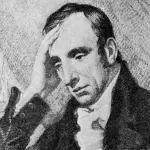
41 His classic studies made a little puzzle, Because of filthy loves of gods and goddesses, Who in the earlier ages raised a bustle, But never put on pantaloons or bodices; His reverend tutors had at times a tussle, And for their Aeneids, Iliads, and Odysseys, Were forced to make an odd sort of apology, For Donna Inez dreaded the mythology.
42 Ovid's a rake, as half his verses show him, Anacreon's morals are a still worse sample,
Time was away and somewhere else, There were two glasses and two chairs And two people with the one pulse (Somebody stopped the moving stairs): Time was away and somewhere else.
And they were neither up nor down; The stream’s music did not stop Flowing through heather, limpid brown,
When they confess that they have lost the penial bone and outer space is Once again a numinous void, when they’re kept out of Other Places, And Dr Fieser falls asleep at last and dreams of unburnt faces, When gold medals are won by the ton for forgetting about the different races, God Bless America.
When in the Latin shanties the scented priesthood suffers metempsychosis And with an organ entry tutti copula the dollar uncrosses
Now that I, tying thy glass mask tightly, May gaze thro’ these faint smokes curling whitely, As thou pliest thy trade in this devil’s-smithy— Which is the poison to poison her, prithee?
He is with her, and they know that I know Where they are, what they do: they believe my tears flow While they laugh, laugh at me, at me fled to the drear Empty church, to pray God in, for them!—I am here.
Grind away, moisten and mash up thy paste, Pound at thy powder,—I am not in haste! Better sit thus and observe thy strange things, Than go where men wait me and dance at the King’s.
Through Alpine meadows soft-suffused With rain, where thick the crocus blows, Past the dark forges long disused, The mule-track from Saint Laurent goes. The bridge is cross'd, and slow we ride, Through forest, up the mountain-side.
The autumnal evening darkens round, The wind is up, and drives the rain; While, hark! far down, with strangled sound Doth the Dead Guier's stream complain, Where that wet smoke, among the woods, Over his boiling cauldron broods.
(from Henry V, spoken by King Henry) Once more unto the breach, dear friends, once more; Or close the wall up with our English dead. In peace there's nothing so becomes a man As modest stillness and humility:
O living pictures of the dead, O songs without a sound, O fellowship whose phantom tread Hallows a phantom ground— How in a gleam have these revealed The faith we had not found.
We have sought God in a cloudy Heaven, We have passed by God on earth: His seven sins and his sorrows seven, His wayworn mood and mirth, Like a ragged cloak have hid from us The secret of his birth.
Once upon a midnight dreary, while I pondered, weak and weary, Over many a quaint and curious volume of forgotten lore— While I nodded, nearly napping, suddenly there came a tapping, As of some one gently rapping, rapping at my chamber door. “’Tis some visitor,” I muttered, “tapping at my chamber door— Only this and nothing more.”
Ah, distinctly I remember it was in the bleak December; And each separate dying ember wrought its ghost upon the floor.
We aged a hundred years and this descended In just one hour, as at a stroke. The summer had been brief and now was ended; The body of the ploughed plains lay in smoke.
The hushed road burst in colors then, a soaring Lament rose, ringing silver like a bell. And so I covered up my face, imploring God to destroy me before battle fell.
I He who has never tasted the grapes of Canaan can only view them from Pisgah.
I have my tides, O sea-foamed Venus, dearer than watercress, pipkins, thyme and clymene. You once held me by the cord of my navel, but I have not died to live in Mahomet’s paradise.
Would that I could gather up my love to me as one does one’s fate, or measure her nature as God does the sea.
We are a weary race that hates seedtime. Poor Persephone, who is Maying springtime, and the coming up of flowers! We remember only what we seed, and Persephone goes down into the earth after Spring and Summer vegetation only because Pluto gave her pomegranate seeds to remember him, but if the seed perish, Persephone will die, and memory shall pass from the earth.
A man of humble blood, with a soul of Kidron, needs a Rachel, but I labored for years in the weary fields for Leah.II The world is a wound in my soul, and I have sought the living waters in meditation, and the angelical fountains in the desert of Beersheba for solitude, for what health there is in friendship comes when one is alone.
I shed tears on the Mount of Olives because people no longer care for each other, but my friends have lacked the character for the vigil. There is no Cana wine in human affections that are not always awake, for people who do not trouble about each other are foes.
It is humiliating being the lamb and bleating to each passerby, “Feed me!” What is the use of saying that men are stones when I know I am going to try to turn them into bread.
I am afraid to say that people are truthful. When a man tells me he is honest I press my hand close to my heart where I keep my miserable wallet. If he says he has any goodness in him, I avoid him, for I trust nobody who has so little fear of the evils that grow and ripen in us while we imagine we have one virtuous trait. These demons lie in ambush in the thick, heady coverts of the blood, where hypocrisy and egoism fatten, waiting to mock or betray us in any moment of self-esteem.
I have no faith in a meek man, and regard anyone that shows a humble mien as one who is preparing to make an attack upon me, for there is some brutish, nether fault in starved vanity.
Yet once a friend leaned as gently on my coat as that disciple had on the bosom of the Saviour, and I went away, not knowing by his affection whether I was the John Christ was said to have loved most. I whispered thanks to my soul because he leaned upon me, for I shall never know who I am if I am not loved.
V Much flesh walks upon the earth void of heart and warm liver, for it is the spirit that dies soonest.
Some men have marshland natures with mist and sea-water in their intellects, and are as sterile as the Florida earth which De Soto found in those meager, rough Indian settlements, and their tongues are fierce, reedy arrows. They wound and bleed the spirit, and their oaks and chestnut trees and acorns are wild, and a terrible, barren wind from the Atlantic blows through their blood as pitiless as the primitive rivers De Soto’s soldiers could not ford.
Do not attempt to cross these mad, tumid rivers, boreal and brackish, for water is unstable, and you cannot link yourself to it.
There are also inland, domestic men who are timid pulse and vetch, and though they may appear as stupid as poultry rooting in the mire, they are housed people, and they have orchards and good, tamed wine that makes men loving rather than predatory; go to them, and take little thought of their ignorance which brings forth good fruits, for here you may eat and not be on guard for the preservation of your soul.
People who have domestic animals are patient, for atheism and the stony heart are the result of traveling: sorrow never goes anywhere. Were we as content as our forefathers were with labor in the fallow, or as a fuller with his cloth, or a drayman with his horses and mules, we would stay where we are, and that is praying.
There are men that are birds, and their raiment is trembling feathers, for they show their souls to everyone, and everything that is ungentle or untutored or evil or mockery is as a rude stone cast at them, and they suffer all day long, or as Paul remarks they are slain every moment.
God forgive me for my pride; though I would relinquish my own birthright for that wretched pottage of lentils which is friendship, I mistrust every mortal.
Each day the alms I ask of heaven is not to have a new chagrin which is my daily bread.
An axe rang sharply ’mid those forest shades Which from creation toward the skies had tower’d In unshorn beauty. There, with vigorous arm Wrought a bold emigrant, and by his side His little son, with question and response, Beguiled the toil. ‘Boy, thou hast never seen Such glorious trees. Hark, when their giant trunks Fall, how the firm earth groans. Rememberest thou The mighty river, on whose breast we sail’d, So many days, on toward the setting sun? Our own Connecticut, compar’d to that, Was but a creeping stream.’ ‘Father, the brook That by our door went singing, where I launch’d
And the angel Israfel, whose heart-strings are a lute, and who has the sweetest voice of all God’s creatures. —KORAN In Heaven a spirit doth dwell “Whose heart-strings are a lute”;
My hair is grey, but not with years, Nor grew it white In a single night, As men's have grown from sudden fears: My limbs are bow'd, though not with toil, But rusted with a vile repose, For they have been a dungeon's spoil, And mine has been the fate of those
Now swarthy Summer, by rude health embrowned, Precedence takes of rosy fingered Spring; And laughing Joy, with wild flowers prank'd, and crown'd, A wild and giddy thing, And Health robust, from every care unbound, Come on the zephyr's wing, And cheer the toiling clown.
Comment form: